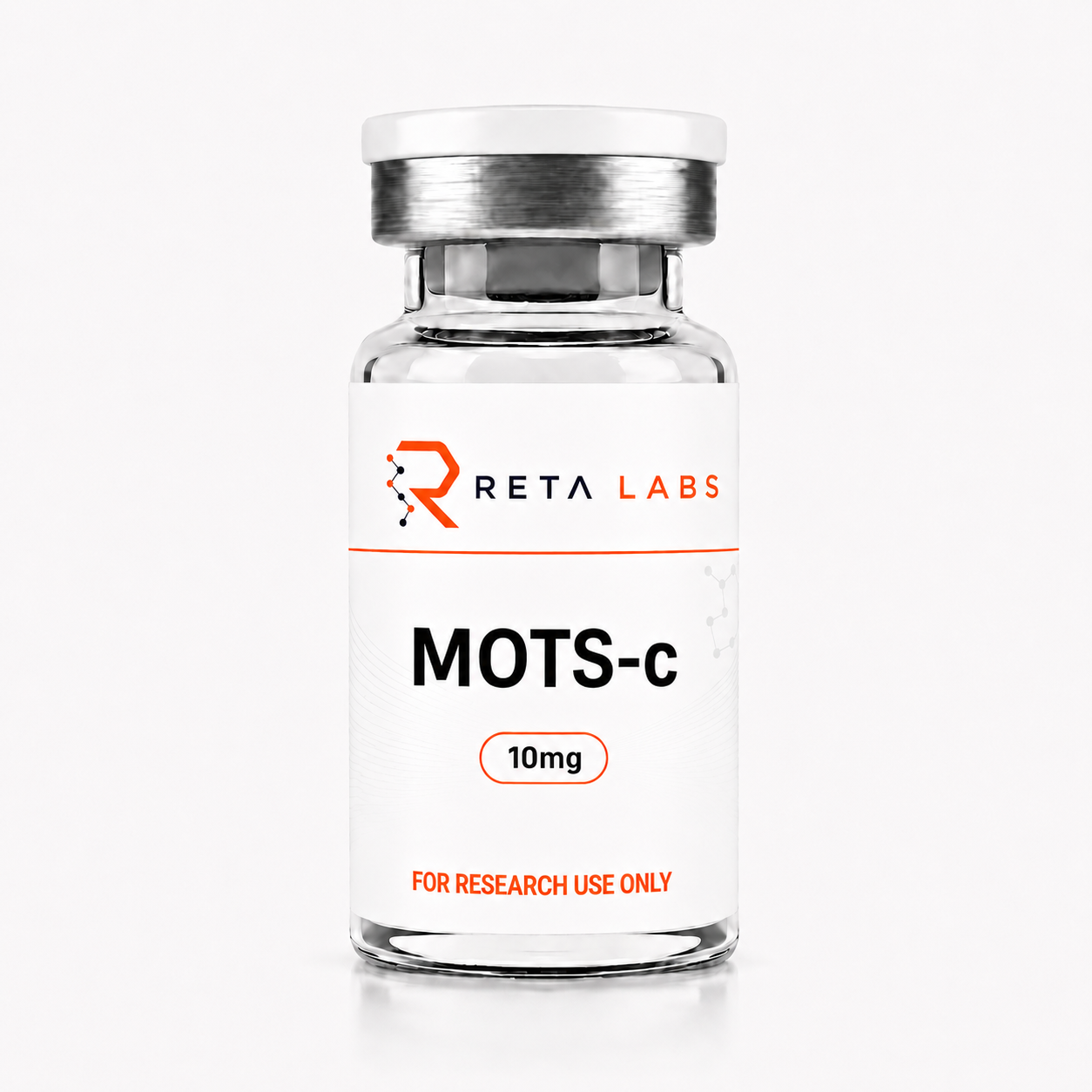
MOTS-c
MOTS-c
In stock
- Lab Tested for Purity & Quality
- Fast & Secure Shipping
- Manufactured in Canada
Couldn't load pickup availability
Product Details
MOTS-c Research Peptide Canada: Mitochondrial-Derived Peptide
MOTS-c is a mitochondrial-derived peptide — a short, 16-amino-acid sequence encoded within mitochondrial DNA. Groups sourcing the MOTS-c research peptide in Canada are typically investigating mitochondrial signalling and metabolic regulation.
Mechanistically, MOTS-c is studied for its association with the AMPK pathway and with cellular responses to metabolic stress, making it a tool of interest in mitochondrial and metabolic research.
Product Details
- Form: Lyophilized peptide
- Net per vial: 10 mg (filled to approximately 104% of label)
- Purity: ≥99% (HPLC-verified)
- Identity: MS-verified (per COA)
- Storage: 2–8 °C, protect from light
- Formula / M.W.: C₁₀₁H₁₅₂N₂₈O₂₂S₂ / 2174.64 Da
- CAS: 1627580-64-6
What Makes MOTS-c a Unique Research Compound
MOTS-c belongs to a small, distinctive class: peptides encoded not in the nuclear genome but within the mitochondrial 12S rRNA region. It was identified around 2015 by Lee, Cohen, and colleagues, and its discovery helped establish the idea that mitochondria themselves can produce signalling peptides.
In research terms, MOTS-c is examined for its influence on metabolic homeostasis, with the AMPK pathway frequently central to the proposed mechanism. Investigators are drawn to it because it links mitochondrial state to whole-cell metabolic signalling — a connection few other tool compounds capture as directly.
Against adjacent metabolic peptides, MOTS-c is unusual in originating from the mitochondrial genome, which is why it recurs in Canadian research on mitochondrial regulation and metabolic stress responses.
Research Benefits
- Metabolic Regulation — MOTS-c is studied for its association with glucose and energy metabolism via AMPK signalling in cellular models.
- Mitochondrial Research — As a mitochondrial-derived peptide, it is a tool for probing mitochondria-to-cell communication.
- Metabolic Stress Response — Research examines its role in how cells respond to metabolic and oxidative stress.
- Aging & Longevity Research — It appears in study panels investigating metabolic contributors to cellular aging.
Related Peptides
- SS-31 — A mitochondria-targeting peptide studied in overlapping research areas.
- NAD+ — A coenzyme examined in cellular-metabolism and longevity research.
- Wolverine Stack — A proprietary blend within the tissue recovery research domain.
Frequently Asked Questions
Is the MOTS-c research peptide available in Canada? Yes. MOTS-c is supplied to Canadian research buyers as a lyophilized, research-grade peptide, HPLC-verified to ≥99% with MS-confirmed identity and a batch-specific COA.
How is MOTS-c different from SS-31? Both relate to mitochondrial research, but MOTS-c is a mitochondrial-derived signalling peptide studied via AMPK and metabolic pathways, whereas SS-31 is a synthetic peptide studied for targeting and stabilising the inner mitochondrial membrane.
Is MOTS-c naturally occurring? The sequence is encoded within mitochondrial DNA, so it has a natural counterpart; the supplied material is a synthesised research-grade version.
How are purity and identity verified? Each batch is HPLC-verified (≥99%) and MS-confirmed, with a batch-specific COA. Material is lyophilized and stored at 2–8 °C, protected from light.
⚠️ For research use only. Not intended for human or veterinary use. Not a drug, food, or supplement.