


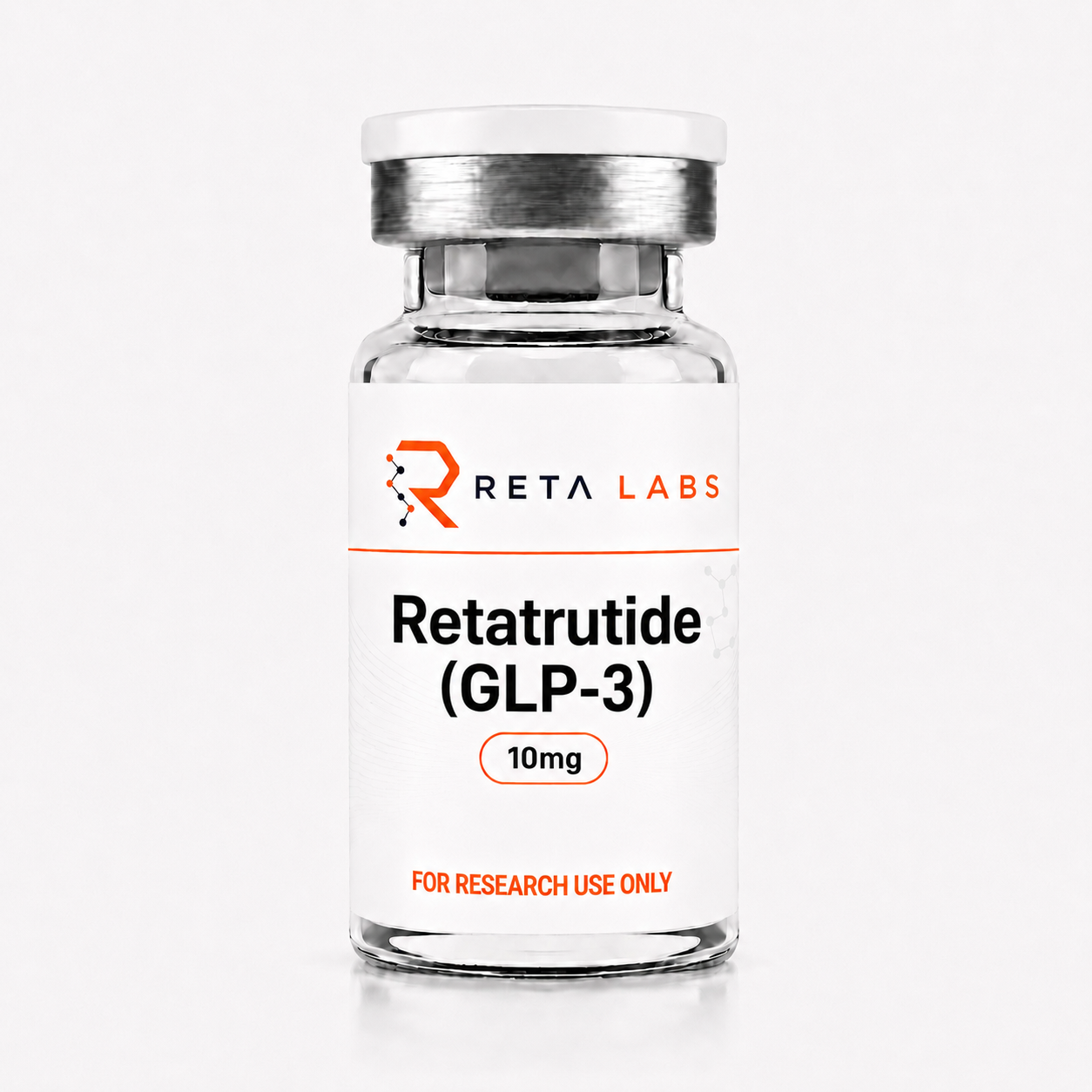
Retatrutide
Retatrutide
In stock
2901 units sold- Lab Tested for Purity & Quality
- Fast & Secure Shipping
- Manufactured in Canada
Couldn't load pickup availability
Product Details
Buy Retatrutide in Canada — Triple-Agonist Research Peptide
Retatrutide (development code LY3437943) is a synthetic single-molecule peptide engineered to act simultaneously at three incretin and metabolic receptors. Research groups looking to buy retatrutide in Canada are generally studying this unusual three-receptor profile within metabolic, glycemic, and energy-balance investigations.
Mechanistically, retatrutide functions as a balanced agonist at the GLP-1, GIP, and glucagon receptors. This combination is of interest to researchers because the three pathways influence insulin secretion, energy expenditure, and hepatic lipid handling through partly distinct routes, making the compound a useful tool for dissecting how multi-receptor signalling differs from single- or dual-pathway models studied to date.
Product Details
- Form: Lyophilized peptide
- Net per vial: 10 mg (filled to approximately 104% of label)
- Purity: ≥99% (HPLC-verified)
- Identity: MS-verified (per COA)
- Storage: 2–8 °C, protect from light
- Formula / M.W.: C221H342N46O68 / 4728.8 Da
- CAS: 2381089-83-2
What Makes Retatrutide a Unique Compound
Retatrutide stands apart from most peptides in its class because it engages three receptors at once rather than one or two. Earlier-generation incretin research tools acted on the GLP-1 receptor alone, and later work introduced dual GLP-1/GIP agonism; retatrutide adds glucagon-receptor activity to that pairing, giving researchers a single molecule with which to study the combined and competing contributions of all three pathways.
The compound originated in the laboratories of Eli Lilly and entered clinical investigation under the identifier LY3437943, with early-phase trial findings reported in the peer-reviewed metabolic literature. It remains an investigational compound rather than an approved product, which is part of why it is handled strictly as a research material. In plain terms, its engineered backbone allows it to bind and activate the GLP-1, GIP, and glucagon receptors with a tuned balance of potency, and substituted residues extend its stability relative to the native hormones it is modelled on.
For investigators, the interest lies in comparison. Set against adjacent compounds — single-agonist and dual-agonist analogues — retatrutide offers a way to ask what the glucagon arm specifically adds to an incretin background. As Reta Labs' manufactured flagship, it is a frequently requested reference material for Canadian groups characterising multi-receptor metabolic signalling.
Key Benefits
- Glycemic & Insulin Regulation — In published metabolic studies, retatrutide has been examined for its influence on insulin secretion and glucose handling, with researchers attributing observed effects partly to combined GLP-1 and GIP receptor engagement.
- Energy Balance & Metabolic Rate — Preclinical and clinical study cohorts have been used to investigate changes in energy expenditure and body weight associated with the compound, with the glucagon-receptor component frequently cited as a variable of interest.
- Hepatic Lipid Metabolism — The literature has explored retatrutide in the context of hepatic fat content, a domain where glucagon-receptor activity is a long-standing subject of metabolic study.
-
Receptor Pharmacology — As a balanced tri-agonist, retatrutide is used as a tool compound to characterise relative receptor potency and downstream signalling compared with single- and dual-agonist references.
- Comparative Incretin Research — It provides a reference point against semaglutide- and tirzepatide-type analogues for studies isolating the contribution of each receptor arm.
- Structure–Stability Studies – Its engineered backbone is examined in research on how sequence modifications affect peptide stability and receptor balance.
Related Peptides
Researchers working with retatrutide often investigate it alongside:
- Tesamorelin — A growth-hormone-releasing analogue studied within overlapping metabolic and hepatic-lipid research contexts.
- MOTS-c — A mitochondrial-derived peptide investigated for metabolic and energy-regulation questions that complement tri-agonist work.
- HGH Fragment 176-191 — A growth-hormone fragment examined in lipid-metabolism research, often grouped with metabolic study panels.
Frequently Asked Questions
Where can I buy retatrutide in Canada for laboratory research?
Retatrutide is available to Canadian research buyers as a lyophilized, research-grade peptide supplied with batch-specific documentation. Each lot is HPLC-verified for purity and MS-confirmed for identity, with a COA available for the specific batch shipped.
How is retatrutide different from tirzepatide or semaglutide?
The distinction is the number of receptors engaged. Semaglutide-type analogues are studied as single GLP-1 receptor agonists and tirzepatide-type analogues as dual GLP-1/GIP agonists, whereas retatrutide adds glucagon-receptor activity, giving researchers a tri-agonist reference rather than a single- or dual-pathway one.
Is retatrutide a naturally occurring peptide?
No. It is a synthetic, engineered molecule modelled on native incretin and glucagon hormones, with sequence modifications intended to balance activity across three receptors and improve stability for study. It does not occur in nature in this form.
How should retatrutide be stored for research?
Lyophilized retatrutide is kept at 2–8 °C and protected from light to preserve integrity. Handling and storage details should follow each research group's own laboratory protocols.
⚠️ For research use only. Not intended for human or veterinary use. Not a drug, food, or supplement.
Smooth ordering process, secure packaging, and prompt delivery.
I’ve placed multiple orders and each has arrived on time
I've been trying peptides for a short time now, and honestly reta has changed my life. It's helped clear up my bloodwork, and I've never felt nor looked as good as I do now!
The product quality appears professional and consistent, good results so far
Was easy to order and came pretty fast