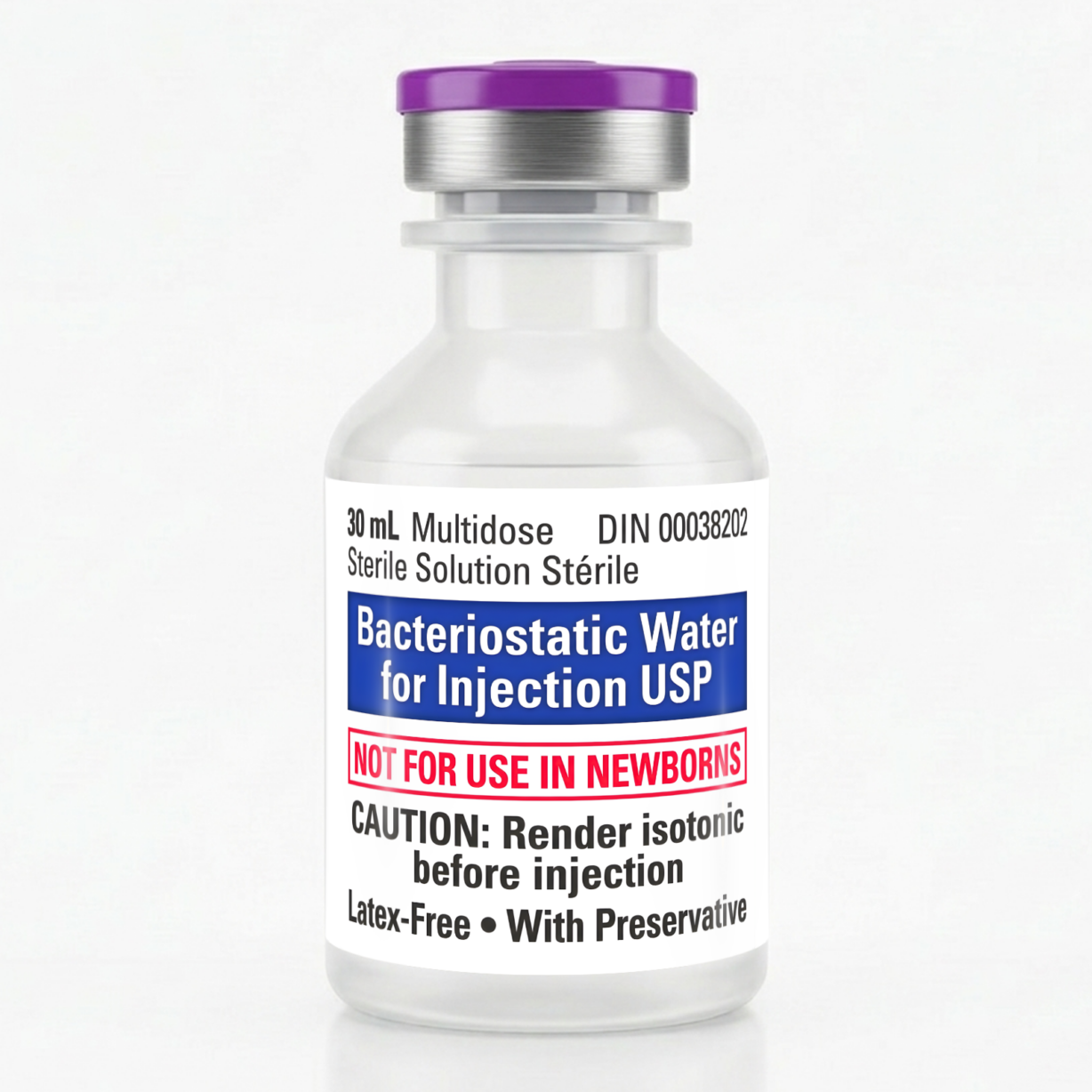
Bacteriostatic Water (BAC) - 30mL
Bacteriostatic Water (BAC) - 30mL
In stock
- Lab Tested for Purity & Quality
- Fast & Secure Shipping
- Manufactured in Canada
Couldn't load pickup availability
Product Details
Bacteriostatic Water Canada — 30 mL Sterile USP-Grade Vials
Bacteriostatic water Canada-shipped from Reta Lbas supplies USP-grade sterile water with 0.9% benzyl alcohol preservative for research peptide reconstitution and laboratory diluent applications. Bacteriostatic water is the standard reconstitution diluent for lyophilized research peptides in multi-dose use contexts, with the benzyl alcohol providing bacteriostatic activity that allows multiple withdrawals from a single vial over extended periods. Each 30 mL vial is filled to label, sealed under aseptic conditions, and shipped domestically across Canada. The product is supplied for research use only.
Product Details
- Form: Sterile aqueous solution
- Net per vial: 30 mL multi-dose vial
- Bacteriostatic agent: 0.9% benzyl alcohol (USP standard)
- Sterility: Sterile-filtered, sealed under aseptic conditions
- Container: Multi-dose vial with rubber stopper
- Storage: Room temperature, protect from freezing
- Grade: USP / research grade
What Bacteriostatic Water Is and What It Isn't
Bacteriostatic water is a defined USP monograph product: water for injection with 0.9% (9 mg/mL) benzyl alcohol added as a preservative. Benzyl alcohol inhibits bacterial growth without sterilizing the solution outright — meaning the vial remains microbiologically stable across repeated punctures of the rubber stopper for the period defined by the manufacturer (typically 28 days from first puncture under standard handling).
What bacteriostatic water isn't: it isn't sterile water for injection (no preservative, single-use), it isn't normal saline (no sodium chloride), and it isn't a buffered solution (no pH-adjusting agents). For laboratory peptide reconstitution work where the same vial of lyophilized compound is drawn from multiple times, bacteriostatic water is the standard diluent because it matches the multi-dose use case. For single-use applications or for compounds that interact unfavorably with benzyl alcohol, sterile water for injection is the alternative.
Among Canadian research laboratories, sourcing decisions for bacteriostatic water typically come down to three factors: USP-grade compliance, vial size matched to typical workflow (30 mL is the most common multi-dose research format), and supply-chain reliability. Our BAC water meets the USP monograph specification, ships from within Canada to avoid border-related interruptions, and is supplied with batch documentation on request.
Quality & Supply Specifications
- USP Monograph Compliance — The 0.9% benzyl alcohol concentration matches the USP bacteriostatic water for injection monograph, the reference specification used in research and clinical supply contexts.
- Multi-Dose Vial Format — 30 mL is the standard research-laboratory format. Larger than the 10 mL clinical format, it supports extended reconstitution work across multiple lyophilized compounds without requiring frequent vial changes.
- Sterile-Filtered Manufacturing — Each vial is filled under aseptic conditions through 0.22 µm sterile filtration. Vial integrity is maintained until first puncture of the rubber stopper.
- Canadian Supply Chain — Orders dispatch from within Canada, avoiding border customs delays and the temperature variations associated with international shipping. This matters less for BAC water than for lyophilized peptides, but matters for delivery time.
Related Compounds
Researchers sourcing bacteriostatic water typically order it alongside lyophilized research peptides:
- BPC-157 — A repair-focused peptide studied as a single-compound counterpart within the same domain.
- TB-500 — A thymosin-derived peptide studied for cell migration and remodelling.
- Retatrutide — Reta Labs' flagship metabolic research peptide, studied in adjacent energy-balance contexts.
Frequently Asked Questions
What is the difference between bacteriostatic water and sterile water for injection?
The defining difference is the 0.9% benzyl alcohol preservative. Sterile water for injection contains only water — no preservatives — and is single-use after the vial is opened, because nothing inhibits microbial growth once the seal is broken. Bacteriostatic water contains 0.9% benzyl alcohol, which inhibits bacterial growth and allows the vial to be punctured multiple times across an extended period (typically 28 days from first puncture under standard handling). For multi-dose laboratory peptide reconstitution work, BAC water is the standard diluent.
Is bacteriostatic water the same as saline?
No. Saline contains 0.9% sodium chloride and is used for tonicity-matched applications. Bacteriostatic water contains 0.9% benzyl alcohol as a preservative and contains no sodium chloride. The two are not interchangeable — research protocols specify one or the other based on the requirements of the compound being reconstituted and the experimental design.
How is BAC water stored?
Bacteriostatic water is stored at room temperature and should not be frozen. The vial remains sealed and microbiologically stable until first puncture, after which it is typically used within 28 days under standard handling. Refer to the manufacturer's labeling for batch-specific stability windows. Our BAC water ships from within Canada under standard ambient conditions, with no cold-chain requirements.
⚠️ For research use only. Not intended for human or veterinary use. Not a drug, food, or supplement.