


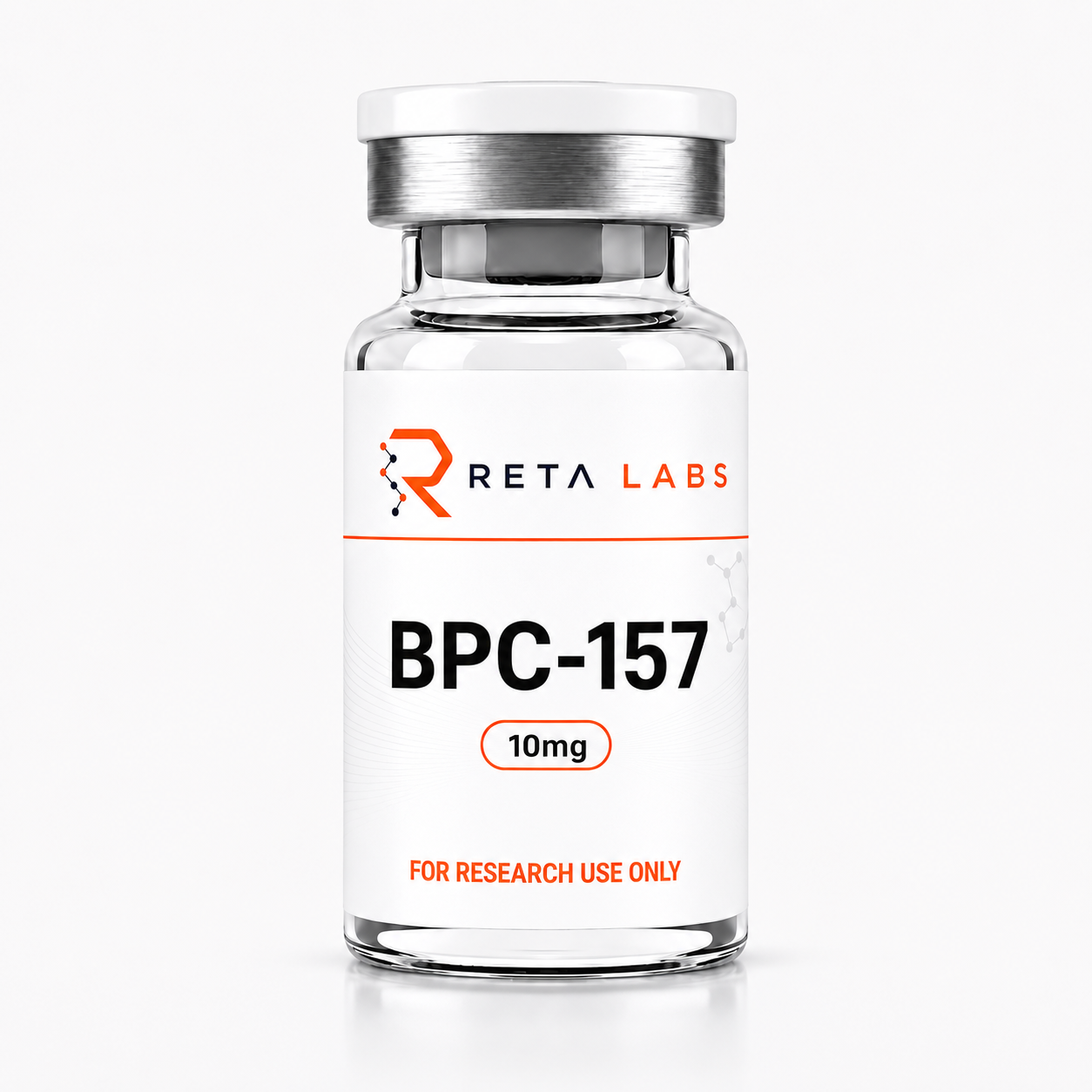
BPC-157
BPC-157
In stock
- Lab Tested for Purity & Quality
- Fast & Secure Shipping
- Manufactured in Canada
Couldn't load pickup availability
Product Details
Buy BPC-157 — Gastric-Derived Pentadecapeptide
BPC-157 is a synthetic pentadecapeptide — a 15-amino-acid sequence derived from a protective protein identified in gastric juice. Research groups who buy BPC-157 are generally studying its activity in tissue-repair, angiogenesis, and gastrointestinal models.
Mechanistically, BPC-157 is investigated for its influence on the formation of new blood vessels and on growth-factor and nitric-oxide signalling pathways. These routes make it a frequently used tool compound in connective-tissue and gut-integrity research.
Product Details
- Form: Lyophilized peptide
- Net per vial: [CONFIRM — common SKU sizes: 5 mg / 10 mg]
- Purity: ≥99% (HPLC-verified)
- Identity: MS-verified (per COA)
- Storage: 2–8 °C, protect from light
- Formula / M.W.: C₆₂H₉₈N₁₆O₂₂ / 1419.55 Da
- CAS: 137525-51-0
What Makes BPC-157 a Unique Compound
BPC-157 — the "body protection compound" — stands out among repair-focused peptides for its reported stability and the breadth of tissue systems in which it has been studied. The sequence was characterised by Sikirić and colleagues at the University of Zagreb beginning in the 1990s, drawn from a larger protein present in gastric fluid.
In plain terms, research attributes its activity to the promotion of angiogenesis and the modulation of growth-factor pathways involved in healing, alongside effects on nitric-oxide systems. Compared with adjacent repair peptides, BPC-157 is often selected because it has been examined across an unusually wide set of tissue models — vascular, connective, and gastrointestinal — within the published literature.
For Canadian research groups, that versatility is the draw: a single, well-characterised reference material that recurs across tissue-repair study designs.
Key Benefits
- Tissue Repair — In study models, BPC-157 has been examined for its association with accelerated repair processes in connective and soft tissue.
- Angiogenesis — Research has investigated the peptide's relationship to the formation of new blood vessels as a contributor to repair.
- Gastrointestinal Research — Much of the foundational literature studied BPC-157 in models of gastrointestinal mucosal integrity.
- Tendon & Ligament Models — The compound is frequently used as a tool in research examining tendon and ligament cell behaviour.
Related Peptides
Researchers working with BPC-157 often investigate it alongside:
- TB-500 — A thymosin-derived peptide studied in overlapping cell-migration and repair contexts.
- GHK-Cu — A copper-binding tripeptide examined in remodeling and wound-healing research.
- Wolverine Stack — A proprietary research blend grouped with tissue-repair study panels.
- Retatrutide (GLP-3) — BPC-157's activity in NAFLD and MASH models pairs with hepatic-lipid research using Retatrutide.
Frequently Asked Questions
Where can I buy BPC-157 for laboratory research in Canada?
BPC-157 is supplied to Canadian research buyers as a lyophilized, research-grade peptide with batch-specific documentation. Each lot is HPLC-verified for purity and MS-confirmed for identity, with a COA matched to the batch shipped.
How is BPC-157 different from TB-500?
Both are studied in tissue-repair contexts, but they derive from different parent proteins and are investigated through different mechanisms — BPC-157 from a gastric protective protein with an angiogenesis emphasis, TB-500 from thymosin beta-4 with a cell-migration emphasis.
Is BPC-157 naturally occurring?
The synthetic peptide is based on a sequence found within a larger protein in gastric juice, but BPC-157 itself as supplied is a synthesised research material rather than an isolated natural product.
How are purity and identity verified?
Each batch is analysed by HPLC (≥99%) and confirmed by mass spectrometry, with a batch-specific COA. Vials are lyophilized and stored at 2–8 °C, protected from light.
⚠️ For research use only. Not intended for human or veterinary use. Not a drug, food, or supplement.
- 5 stars: 3 (100%)
- 4 stars: 0 (0%)
- 3 stars: 0 (0%)
- 2 stars: 0 (0%)
- 1 star: 0 (0%)
Decided to try these guys out and can say they seem to be pretty good quality, results are working
Very competitive pricing
will be buying again