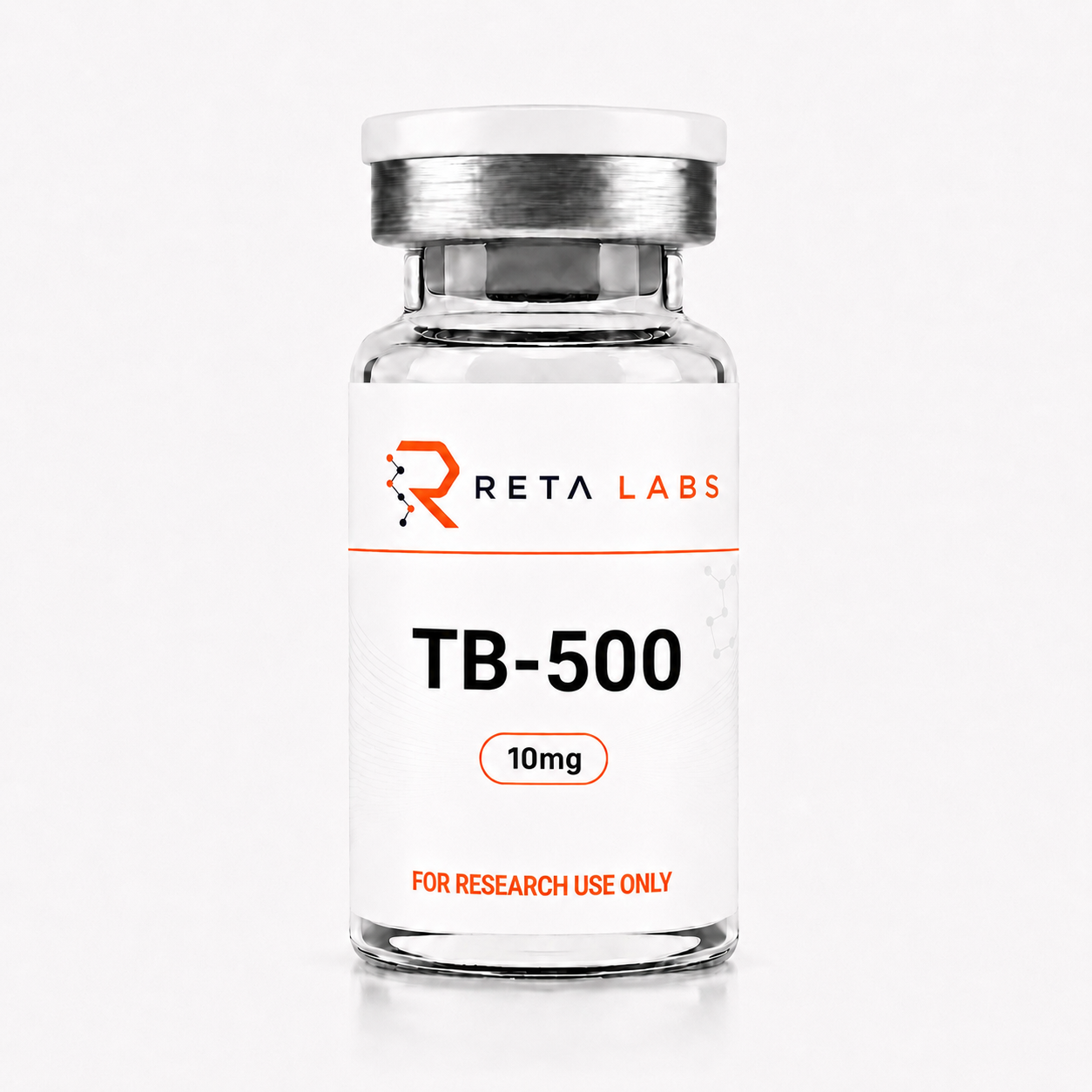
TB-500
TB-500
In stock
620 units sold- Lab Tested for Purity & Quality
- Fast & Secure Shipping
- Manufactured in Canada
Couldn't load pickup availability
Product Details
Buy TB500 Peptides — Synthetic Thymosin β-4
TB-500 peptides are a synthetic version of an active fragment of thymosin beta-4, a naturally occurring actin-binding protein. Researchers sourcing tb500 peptides are usually studying cell migration, repair, and angiogenesis in laboratory models.
Mechanistically, TB-500 is investigated for its interaction with actin — a key cytoskeletal protein — and the downstream effects on cell motility and tissue remodelling. This makes it a common tool in regenerative and wound-healing research.
Product Details
- Form: Lyophilized peptide
- Net per vial: 10 mg (filled to approximately 104% of label)
- Purity: ≥99% (HPLC-verified)
- Identity: MS-verified (per COA)
- Storage: 2–8 °C, protect from light
- Formula / M.W.: C₂₁₂H₃₅₀N₅₆O₇₈S / 4963.44 Da
- CAS: 77591-33-4
What Makes TB-500 a Unique Compound
TB-500 corresponds to a short, active region of thymosin beta-4, the protein responsible for much of the cell's regulation of actin. Where many repair peptides act on growth-factor signalling, TB-500's research interest centres on the cytoskeleton itself — the machinery cells use to move, divide, and reorganise during repair.
The parent protein, thymosin beta-4, has been studied across regenerative biology for decades; TB-500 gives researchers a synthetic handle on its actin-binding activity in a defined, reproducible form. In published work, that activity is linked to cell migration and to the formation of new vasculature.
Set against adjacent repair compounds, TB-500 is frequently chosen when a study's focus is cell motility and remodelling rather than vascular signalling alone — which is why it so often appears alongside, and is compared with, BPC-157 in Canadian repair research.
Key Benefits
- Cellular Migration — TB-500 is studied for its role in promoting the movement of cells during tissue remodelling, attributed to its actin-binding activity.
- Tissue Repair — Research has examined the fragment within models of soft-tissue and muscle repair.
- Angiogenesis — The literature investigates its association with new blood-vessel formation.
- Cytoskeletal Research — s a thymosin-derived tool, it is used to probe actin dynamics specifically.
- Anti-Inflammatory Modulation — Cell-based and animal studies have measured reductions in inflammatory cytokine expression and modulation of NF-κB signaling, framing TB-500 as a candidate for investigation into inflammation-coupled tissue repair.
Related Peptides
Researchers working with TB-500 often investigate it alongside:
- BPC-157 — repair-focused peptide frequently studied alongside TB-500 for comparison.
- GHK-Cu — A copper tripeptide examined in remodeling research.
- Wolverine Stack — A proprietary research blend within the tissue-repair domain.
- Retatrutide (GLP-3) — TB-500's cardiac-research literature complements cardiometabolic designs incorporating Retatrutide.
Frequently Asked Questions
Are TB-500 peptides available for research in Canada?
Yes. TB-500 peptides are supplied to Canadian research buyers as lyophilized, research-grade material, HPLC-verified to ≥99% with MS-confirmed identity and a batch-specific COA.
How is TB-500 different from BPC-157?
TB-500 derives from thymosin beta-4 and is studied mainly through actin-binding and cell-migration mechanisms, whereas BPC-157 derives from a gastric protective protein and is studied with more emphasis on angiogenesis and growth-factor pathways.
Is TB-500 naturally occurring?
It is a synthetic fragment modelled on a region of the natural protein thymosin beta-4; the supplied peptide is manufactured rather than extracted.
⚠️ For research use only. Not intended for human or veterinary use. Not a drug, food, or supplement.