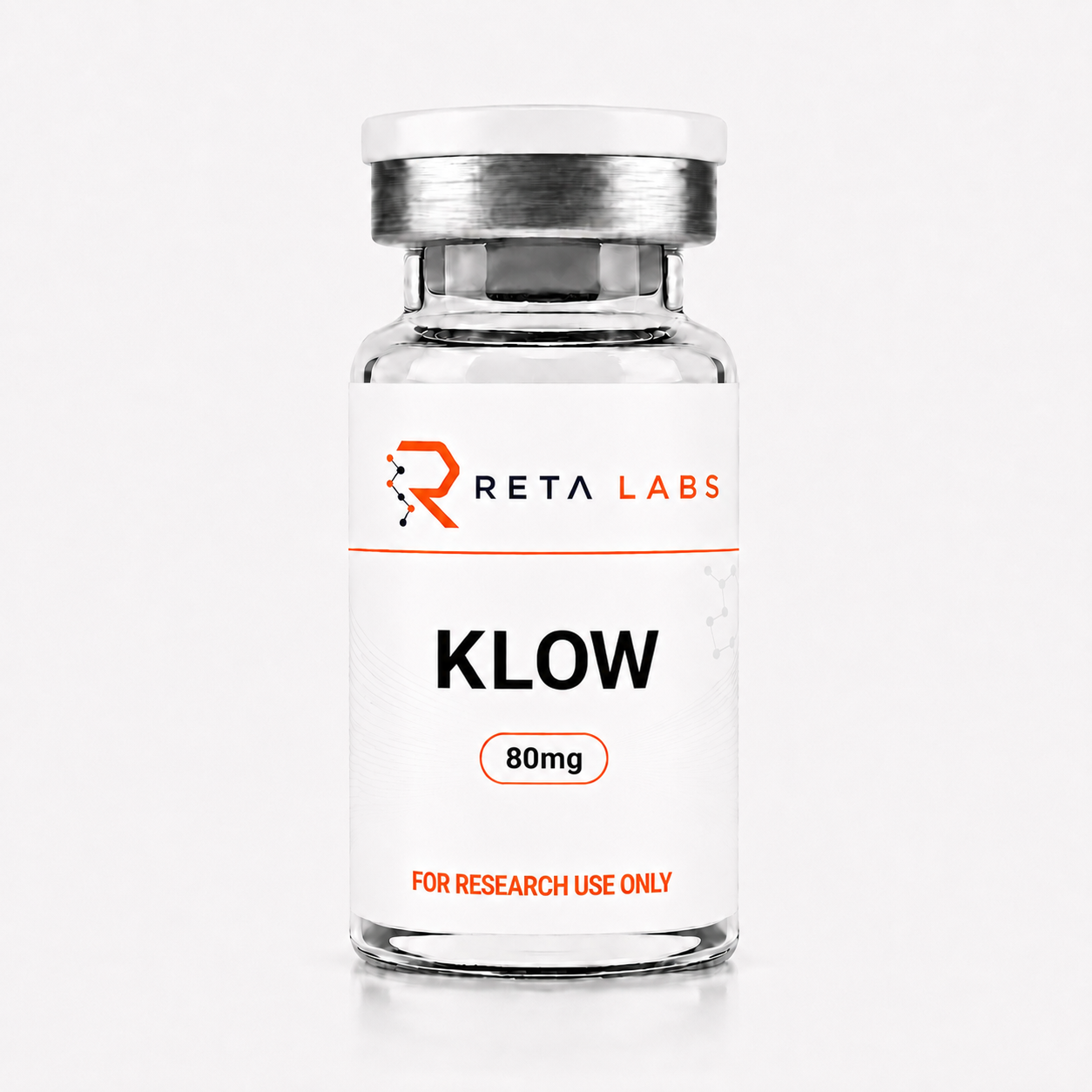
KLOW Stack (BPC-157 + TB-500 + GHK-Cu + KPV)
KLOW Stack (BPC-157 + TB-500 + GHK-Cu + KPV)
In stock
- Lab Tested for Purity & Quality
- Fast & Secure Shipping
- Manufactured in Canada
Couldn't load pickup availability
Product Details
KLOW Stack 80mg — Multi-Peptide Research Blend
KLOW Stack is a multi-peptide research blend combining GHK-Cu, BPC-157, TB-500, and KPV into a single lyophilized research formulation. Researchers studying tissue biology, cellular signaling, extracellular-matrix remodeling, and inflammatory pathways may use the individual components as complementary research tools representing distinct biological mechanisms.
The standard 80mg KLOW formulation contains 50mg GHK-Cu, 10mg BPC-157, 10mg TB-500, and 10mg KPV. Each component has an independent research literature: GHK-Cu is studied extensively in extracellular-matrix and skin biology, BPC-157 in preclinical tissue and vascular research, TB-500 in cellular migration and cytoskeletal research, and KPV in inflammatory and epithelial models. The combination itself should be regarded as a research formulation rather than a clinically validated therapeutic product.
Product Details
- Form: Lyophilized peptide blend
- Net per vial: 80 mg total peptide content
- Composition: 50 mg GHK-Cu + 10 mg BPC-157 + 10 mg TB-500 + 10 mg KPV
- Purity: ≥99% (HPLC-verified)
- Identity: MS-verified (per COA)
- Storage: 2–8 °C, protect from light
What Makes KLOW Stack a Unique Compound
KLOW Stack differs from single-peptide research materials because it combines four chemically distinct peptides with different research profiles in one formulation. Rather than representing a single molecular mechanism, the blend brings together research involving extracellular-matrix biology, vascular and tissue signaling, cellular migration, and inflammatory pathways.
GHK-Cu is a copper-binding tripeptide studied in extracellular-matrix remodeling, collagen-related research, skin biology, and cellular signaling. BPC-157 is a synthetic pentadecapeptide investigated primarily in preclinical research involving tissue biology, vascular signaling, connective tissue, and gastrointestinal models. TB-500 is associated with thymosin β4 research and is investigated in relation to actin dynamics, cellular migration, and tissue remodeling. KPV is a three-amino-acid peptide corresponding to the C-terminal sequence of α-MSH and has been studied in inflammatory and epithelial research.
For investigators, the interest in KLOW lies in the ability to study these different research pathways within a single formulation. The blend can therefore serve as a reference material for multi-pathway experimental designs, while individual components can be evaluated separately when researchers need to isolate mechanism-specific effects. Importantly, research findings involving an individual component should not automatically be attributed to the complete KLOW formulation.
Key Benefits
- Multi-Pathway Research — Combines four distinct research peptides associated with extracellular-matrix biology, tissue signaling, cellular migration, and inflammatory pathways, providing a broad tool for multi-pathway laboratory investigations.
- GHK-Cu & Matrix Biology — GHK-Cu has been investigated in collagen-related research, extracellular-matrix remodeling, skin biology, and cellular signaling, making it the largest component of the formulation.
- BPC-157 & Tissue Research — BPC-157 has an extensive preclinical research history involving connective tissue, vascular biology, gastrointestinal models, and experimental tissue-repair systems.
- TB-500 & Cellular Migration — TB-500 is associated with thymosin β4 research involving actin dynamics, endothelial responses, cellular migration, and tissue remodeling.
- KPV & Inflammatory Signaling — KPV has been investigated in experimental inflammatory and epithelial models, providing a distinct research pathway within the four-component formulation.
- Complementary Research Profiles — The four components represent different areas of peptide research, allowing investigators to examine relationships between cellular signaling, tissue remodeling, vascular biology, and inflammatory pathways.
- Single-Formulation Research — Provides researchers with a standardized four-peptide formulation for experimental designs where multiple research compounds are being investigated together.
Related Peptides
Researchers working with KLOW Stack often investigate its individual components and related research peptides alongside the blend:
- GHK-Cu — A copper-binding peptide studied extensively in extracellular-matrix, skin, collagen, and cellular research.
- BPC-157 — A pentadecapeptide investigated primarily in preclinical tissue, vascular, gastrointestinal, and musculoskeletal research.
- TB-500 — A research peptide associated with thymosin β4 and cellular migration, actin dynamics, and tissue-remodeling research.
- KPV — A short α-MSH-derived peptide investigated in inflammatory signaling and epithelial research.
- Wolverine Stack — A BPC-157 and TB-500 research combination used to investigate complementary tissue and cellular pathways.
Frequently Asked Questions
What is the KLOW Stack?
KLOW Stack is a multi-peptide research blend containing GHK-Cu, BPC-157, TB-500, and KPV. The standard formulation contains 80mg of total peptide material distributed across the four components.
What peptides are in KLOW Stack?
The standard KLOW Stack formulation contains 50mg GHK-Cu, 10mg BPC-157, 10mg TB-500, and 10mg KPV. Each component is a distinct peptide with its own research literature and biological profile.
How much of each peptide is in KLOW Stack?
The standard 80mg formulation contains 50mg GHK-Cu, 10mg BPC-157, 10mg TB-500, and 10mg KPV. Researchers should verify the composition against the product label and batch-specific documentation supplied with the material.
What is KLOW Stack studied for?
KLOW Stack is intended as a research formulation for investigating multiple biological pathways, including extracellular-matrix remodeling, tissue biology, cellular migration, inflammatory signaling, vascular biology, and epithelial research. These research applications are primarily based on studies of the individual components rather than clinical studies of the complete KLOW formulation.
Is KLOW Stack one peptide?
No. KLOW Stack is a combination of four chemically distinct peptides: GHK-Cu, BPC-157, TB-500, and KPV. The formulation is therefore different from a single-molecule peptide such as retatrutide.
How is KLOW Stack different from the Wolverine Stack?
The Wolverine Stack contains BPC-157 and TB-500, while KLOW Stack adds GHK-Cu and KPV to those two components. KLOW therefore provides a broader four-peptide research formulation spanning additional extracellular-matrix and inflammatory research pathways.
How is KLOW Stack different from the Glow Stack?
The Glow Stack contains GHK-Cu, BPC-157, and TB-500. KLOW Stack contains those three components plus KPV, adding an additional peptide associated with inflammatory and epithelial research.
Has the complete KLOW Stack been clinically studied?
The individual components have been investigated in laboratory and preclinical research, but the complete four-peptide KLOW formulation should not be represented as clinically validated. Research findings involving individual components do not establish the safety or efficacy of the complete combination.
How should KLOW Stack be stored for research?
Lyophilized KLOW Stack is stored at 2–8 °C and protected from light. Researchers should follow the storage requirements provided with the specific batch and their own laboratory protocols for handling and preservation.
⚠️ For research use only. Not intended for human or veterinary use. Not a drug, food, or supplement.